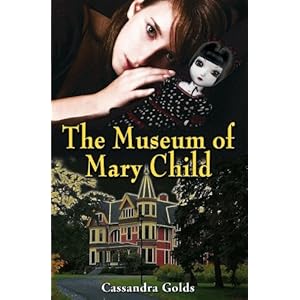
Golds, Cassandra. The Museum of Mary Child. Tulsa, OK: Kane Miller, 2009.
Summary:
Heloise is a child being raised by her stern godmother in the caretaker's house of a museum which lies next door. Her days are strictly structured, and allow no room for fun or free time. She does not know love, the joys of Christmas, or the joys of playing with other children. One day, Heloise finds a doll underneath her floorboards, and develops a fondness for it. Her godmother, however, disapproves and decides to show Heloise the contents of the museum, which contains the disfigured faces of thousands of dolls sewn by Mary Child in her madness. Heloise, aided by a band of birds led by Merryfeathers, escapes from her godmother to be taken in by Old Mother who leads a choir of orphan girls. Heloise begins living a wonderful life, until Merryfeathers takes her to a prison, where she meets Sebastian. They develop a bond and find that they have a mutual connection with Mary Child. Heloise is suddenly found and called back to her godmother who is sick, where she discovers the truth about Mary Child, and the truth about herself.
My Impressions:
This book is a rather dark and strange book, although put together very well. The characters of the story are not developed with much detail, adding to the overall feeling of mystery about the book. In addition, the overall theme of love conquering all is well played throughout the book right through the end. The plot of the story moves along at a steady pace, not so slow that it is dull, but not so quick as to be a rapid page-turner. However, the mysterious air of the plot, the languague that seems to be from the nineteenth century, the fairy tale elements, and the satisfying ends make this book a worthwhile read, especially for females who will most likely receive more enjoyment out of it than males.
Suggestions for the use of this book:
This book is a powerful story and would be an excellent recommendation for any young adult who enjoys mystery. This book could also be used in a lesson on the gothic novel, as it contains many elements of a gothic novel.
Reviews:
Miller, Jessica. Review of The Museum of Mary Child, by Cassandra Golds. School Library Journal, December 1, 2009.
Heloise lives in an austere household with her godmother, always watched, always working, never wasting time. Her life is regimented into segments of work, study, and constitutionals. This is all that the girl knows, until she finds a doll under a loose floorboard in her bedroom. Suddenly her world changes as she discovers what it means to love, but the child knows to keep the toy hidden. When her godmother learns of its existence, she takes her to the Museum of Mary Child to demonstrate the folly and danger of keeping dolls. To the girl's horror, she discovers the place is a shrine to the dolls that a woman named Mary Child had once kept, defaced, and hidden as she slowly went mad. Overcome, Heloise runs away and is taken in by kind Old Mother who runs an all-female choir. There the girl begins to develop loving friendships. Her world is again turned upside down when she is taken by a flock of birds to meet a prisoner in the jail during the dark of night. After several visits to the prison, the two share their stories and discover a deep and intriguing connection between them and Mary Child. This story reads like a fairy tale with elements of mystery, romance, Gothic horror, fantasy, and all parts terrific. The atmosphere is wonderfully rendered, and the book quietly but dramatically draws readers to its conclusion.
Review of The Museum of Mary Child, by Cassandra Golds. Publisher's Weekly, September 28, 2009.
Gothic and wonderfully creepy, Golds's (Clair-de-Lune) atmospheric story delights, offering meditations on the nature and power of love. Lonely Heloise wants only to be loved, but lives as if jailed in the house of her stern and sometimes cruel godmother. One day Heloise uncovers a beautiful doll, Maria, hidden under the floorboards of her room, and it is love at first sight. Heloise hides Maria from her godmother, whose personal Ten Commandments include forbidding play, "pretty clothes" and the possession of a doll, not to mention never uttering the word love ("We are all of us evil. And to love something evil is wicked," she professes). Once Maria is discovered, Heloise finds out the horrible truth about the museum that adjoins her godmother's cottage and is thrust down a strange and magical path that reveals how sheltered she has been ("Most people, she now knew, had heard music. Most people had seen pictures"). Readers will wonder throughout: who is Heloise really-or better, what is she? Aside from an occasional tendency toward sentimental prose, Golds's novel is pure fun, filled with mystery and nearly impossible to put down.

No comments:
Post a Comment