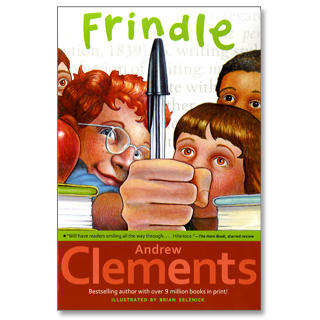
Clements, Andrew. Frindle. New York: Simon & Schuster, 1996.
Summary:
Frindle recounts the story of Nick Allen, a student at Lincoln Elementary School, who decides to see if he can create his own word. His Language Arts teacher, Mrs. Granger, tells the class that words have meanings because people say that they do. Nick Allen puts this to the test by beginning to call pens, frindles. This puts him at odd with his teacher, but gains him the support of the rest of the school and eventually gains nationwide attention. Nick Allen later finds out that, even though she appeared to be against him, Mrs. Granger was supportive of Nick's efforts to create a new word.
My Impressions:
This is an excellent book that speaks to children of pre-Middle School age. The book gives support to children who may not necessarily fit into the common mold with their ideas and imagination. The book is well written, and gives young children the idea that they are able to accomplish something if they try, and that having an imagination is not a bad thing.
Suggestions for the use of this book:
This book could be used in a lesson on the etymology of different words. This is an excellent example of the way in which words are created. This book could also be used by a parent to explain to a child why they do not necessarily get along with their teacher.
Reviews
Review of Frindle, by Andrew Clements. Publisher's Weekly, July 15, 1996.
Always one step ahead of his teachers, Nick not only can "feel a homework assignment coming the way a farmer can feel a rainstorm" but can dream up a distraction to prevent the assignment from being given. In fifth grade, however, he meets his match in tough language-arts teacher Mrs. Granger. Just to get under her skin?nd despite her loud protests?e invents the word "frindle" and convinces the whole school to use it instead of the word "pen." The word spreads to the city, nation and world, and Clements (Big Al) fast-forwards the story by 10 years to show that "frindle" has made it into the dictionary. With this coup Nick gets a big surprise: the proof that Mrs. Granger was rooting for "frindle" all along. Like the Velveteen Rabbit, his well-worn word has become real. Dictionary lovers will cotton to this mild classroom fantasy, while readers who have a hard time believing that one person could invent a word out of thin air will be surprised to learn that the word "quiz" was invented the same way.
Mitnick, Fritz. Review of Frindle, by Andrew Clements. School Library Journal, December 1, 1998.
Nick, a clever fifth grade students, is determined to outsmart his no-nonsense, dictionary-loving teacher, Mrs. Granger. When he invents "Frindle," a new word for pen, he manages to get fellow students and shopkeepers to use the word. Annoyed, Mrs. Granger keeps students who use the new word after school. The war over the word escalates, and first local and then national media pick up the story. Marketing rights to tie-ins (such as pens marked "Frindle") make Nick very wealthy. Ten years later, Nick and Mrs. Granger again correspond when the word "Frindle" is admitted to Mrs. Granger's favorite dictionary. Andrew Clements' story (S&S, 1996) is a fresh take on the classic student-teacher relationship.

Korman, Gordon. Son of the Mob. New York: Hyperion, 2002.
Summary:
Vince Luca is a high school student who is the son of a mob boss. Vince, however, has no desire to join the family business, and goes out of his way to avoid "the life." However, Vince's life becomes complicated when he begins dating the daughter of the FBI agent who has the Luca house bugged and under surveillance. Vince also, inadvertantly, gets involved with some of the family's business dealings and winds up in a mess. Vince must maintain his relationship with his family, and his relationship with his girlfriend at the same time, which leads to many complications and ultimately Vince has to compromise.
My Impressions:
This book holds many elements of the reality of being a teenager, including stressful relationships with parents, first love, and striving for independence. This book does an excellent job of placing a teenager into an uncommon situation. While teenage readers will be able to identify with the character of Vince Luca, they will also enjoy the unique situations that he is put into due to his family's connection with the mob. The unique plot, and the realistic dialogue makes this book an excellent choice for young adult readers.
Suggestions for the use of this book:
This would be an excellent book to recommend to a teenage boy who is searching for something to read, particularly if they have trouble understanding Shakespeare's Romeo and Juliet or if they enjoy movies such as the Godfather or TV shows such as the Sopranos.
Reviews
Carstensen, Angela. Review of Son of the Mob, by Gordon Korman. Voice of Youth Advocates, February 1, 2003.
Vince Luca is a recognizable modern teenager-fast-talking, unmotivated, and down on what his father does for a living. When one's dad is the leader of organized crime in New York, living an independent life is a challenge. Although Vince is determined to stay completely separate from the family business, it somehow interferes with every aspect of his senior year, from playing football to homework projects. When Vince falls for Kendra, the daughter of the FBI agent gathering evidence against his father, their relationship seems doomed from the start. Several questions keep the reader hooked. Will Kendra find out why Vince avoids meeting her parents? Will their parents catch them together? What happens if her father succeeds? Is there an FBI mole in the Luca operations? Who ordered the shooting of Mr. Luca's rival? What makes the story work is the hip, young voice of the protagonist. Vince is well aware of the absurdity of his situation and has a wonderfully dry sense of humor. His genuine struggle to find his own way in the face of family influences is appealing and grounds the story. Although this book will be most popular with the junior high crowd, older students who appreciate humorous writing will enjoy the clever twist on a Romeo-and-Juliet relationship. The popularity of HBO's The Sopranos should also serve to increase its audience.
Peters, John. Review of Son of the Mob, by Gordon Korman. Booklist, November 1, 2002.
The Sopranos meets Romeo and Juliet in this briskly comic romance, costarring a crime kingpin's son and an FBI agent's daughter. Tony and Kendra are mad for each other, but that doesn't mean that Tony is ready to tell Kendra who his father is--especially after his horrifying discovery that her father is on the listening end of the bugs and wiretaps scattered through his house. Realizing that it wouldn't be wise for either dad to find out what's what, Tony has to do some fancy footwork to keep the fathers, and Kendra's suspicions, at bay--a task considerably complicated by his unwilling involvement with a pair of petty hoodlums. Stubbornly battling to preserve his illusion that the family "business" has nothing to do with him, Tony presents a winning mix of good instincts and innocence that will have readers cheering him on as he weathers a succession of amatory and ethical crises, to emerge at the end of this expertly plotted escapade with relationships, self-respect, and even conscience more or less intact.

No comments:
Post a Comment