
Myers, Walter Dean. Monster. New York: Harper Tempest, 1999.
Summary:
This book recounts the story of Steve Harmon, a sixteen year old African-American who is on trial for aiding in the robbery of convenience store, during which the owner of the store was killed. The book is written in the combination of a movie script and journal. Steve decides to recount his story as a movie in order to cope with life in prison. Through this book, the reader glimpses the harsh reality of life in prison, the pain of Harmon's family, and the humiliation of a trial.
My Impressions:
This book speaks to the confusing emotions encountered by sixteen year old boys, and adds in the turmoil of being in prison for a crime that the prisoner did not commit. This book provides a harsh and realistic view into the justice system of the United States, particularly where young African-Americans are involved. Young adult readers will appreciate the reality of the book that does not gloss over any issue, and readers will also appreciate the harsh ending which does present the main character as living happily ever after.
Suggestions for the use of this book:
This book would be an excellent read for a young adult who is interested in the justice system. While the book is fiction, the portrayal of prison life and a trial appears to be well researched and provides an accurate portrayal of the way in which justice is carried out.
Reviews:
Carton, Debbie. Review of Monster, by Walter Dean Myers. Booklist, May 1, 1999.
Myers combines an innovative format, complex moral issues, and an intriguingly sympathetic but flawed protagonist in this cautionary tale of a 16-year-old on trial for felony murder. Steve Harmon is accused of acting as lookout for a robbery that left a victim dead; if convicted, Steve could serve 25 years to life. Although it is clear that Steve did participate in the robbery, his level of involvement is questionable, leaving protagonist and reader to grapple with the question of his guilt. An amateur filmmaker, Steve tells his story in a combination of film script and journal. The "handwritten" font of the journal entries effectively uses boldface and different sizes of type to emphasize particular passages. The film script contains minimal jargon, explaining camera angles (CU, POV, etc.) when each term first appears. Myers' son Christopher provides the black-and-white photos, often cropped and digitally altered, that complement the text. Script and journal together create a fascinating portrait of a terrified young man wrestling with his conscience. The tense drama of the courtroom scenes will enthrall readers, but it is the thorny moral questions raised in Steve's journal that will endure in readers' memories. Although descriptions of the robbery and prison life are realistic and not overly graphic, the subject matter is more appropriate for high-school-age than younger readers.
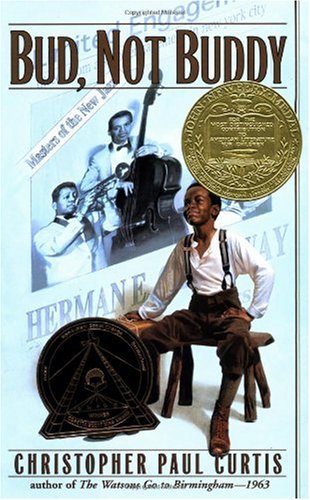
Curtis, Christopher Paul. Bud, Not Buddy. New York: Scholastic, Inc., 1999.
Summary:
This book recounts the story of Bud Caldwell, a young African-American orphan living in Michigan during the Great Depression. After a disastrous experience with a foster family, Bud decides to run away from his home town in order to find his father, whom he has never met. With everything that he owns in an old suitcase, Bud sets out for Grand Rapids, Michigan and, with some help along the way, finds the man who he thinks is his father only to be encountered with a surprise and a new home.
My Impressions:
This story is a creative one that includes historical details of the Great Depression, including bread lines and Hoovervilles. The character of Bud is an easy to like ten year old boy, who just wants to find where he belongs. The book is excellently written, and provides the young reader a glimpse into the life of someone like themselves, but in a different era. Readers will grow fond of the young main character and will love the unexpected ending.
Suggestions for the use of this book:
This book could be used for any lesson on life during the Great Depression. This book provides a child's insight into what life would be like for a child growing up during this era.
Reviews:
Andersen, Beth E. Review of Bud, Not Buddy, by Christopher Paul Curtis. Voice of Youth Advocates, February 2, 2000.
Curtis's magical touch in his debut novel, The Watsons Go to Birmingham-1963 (Delacorte, 1995), is once again evident in all its powerful, funny glory in his latest lovely novel. Ten-year-old Bud Caldwell, wise beyond his years, is hit particularly hard by the Depression in 1936. Bud has been bounced back and forth between a Flint, Michigan, orphanage and foster care since his mother died when he was six. Fed up with beatings from those who take him in, Bud grabs his few meager treasures and sets out in search of his father. With determination and a cautious but curious spirit, Bud heads for Grand Rapids, home of Herman E. Calloway, legendary bass player and leader of a renowned jazz band. Convinced that Calloway is his long-lost father, Bud seeks a reunion. Bud's only guidebook is Bud Caldwell's Rules and Things for Having a Funner Life and Making a Better Liar out of Yourself, his own set of poignant, riotous tips for preserving sanity. In a scene of stunning hilarity, Bud is rescued by Lefty Lewis, who takes Bud to Grand Rapids, where the child learns yet again that life is not always what it seems. Curtis writes with a razor-sharp intelligence that grabs the reader by the heart and never lets go. His utterly believable depiction of the self-reliant charm and courage of Bud, not Buddy, puts this highly-recommended title at the top of the list of books to be read again and again.

No comments:
Post a Comment