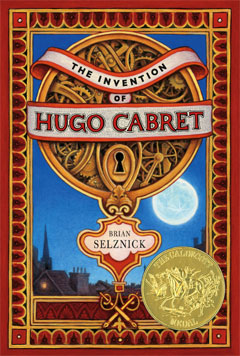
Citation:
Selznick, Brian. The Invention of Hugo Cabret. New York: Scholastic Press, 2007.
Summary:
The book revolves around the character of a young boy named Hugo Cabret who is living inside the walls of a Paris train station in 1931. He has lived in the train station since the untimely death of his father in a museum fire, after which he was taken to live with his uncle who kept the clocks running in the train station. Hugo has one link to his father which is a mechanical machine formed to look like a person holding a pen over a writing desk. This machine was found by Hugo's father, and he was in the process of restoring it when he died. Hugo spends his free time attempting to fix the machine, and in order to do so must steal mechanical parts from a toymaker who has a booth inside the train station. When he is caught by the toymaker, he begins learning that the automaton his father was restoring and the toymaker are linked together, culminating in the revelation of the toymaker's true identity.
My impressions:
This is an expertly written and illustrated book which moves quickly. The use of illustrations to tell large parts of the story is well done, so that the reader feels as if they are watching a black and white movie rather than reading a book, which ties in with the plot of the book which involves the early days of film. While the illustrations lack color, they are rich in detail so that the reader misses no part of the plot due to lack of words. In addition, the storyline is well thought out with questions brought up that are later answered at just the right time. This technique makes the book suspenseful and a fast read.
Suggestions for the use of this book:
This book is an excellent choice to recommend to older children who do not necessarily enjoy reading. The fast moving plot and the large amount of pictures would, theoretically, make the book enjoyable to the child who does not like to read, or even a child who has trouble reading. They will be able to grasp the plot from the illustrations, and then will have read a quality book that they find enjoyable.
Reviews:
Lukehart, Wendy. Review of The Invention of Hugo Cabret, by Brian Selznick. School Library Journal, March 1, 2007.
With characteristic intelligence, exquisite images, and a breathtaking design, Selznick shatters conventions related to the art of bookmaking in this magical mystery set in 1930s Paris. He employs wordless sequential pictures and distinct pages of text to let the cinematic story unfold, and the artwork, rendered in pencil and bordered in black, contains elements of a flip book, a graphic novel, and film. It opens with a small square depicting a full moon centered on a black spread. As readers flip the pages, the image grows and the moon recedes. A boy on the run slips through a grate to take refuge inside the walls of a train station-home for this orphaned, apprentice clock keeper. As Hugo seeks to accomplish his mission, his life intersects with a cantankerous toyshop owner and a feisty girl who won't be ignored. Each character possesses secrets and something of great value to the other. With deft foreshadowing, sensitively wrought characters, and heart-pounding suspense, the author engineers the elements of his complex plot: speeding trains, clocks, footsteps, dreams, and movies-especially those by Georges Melies, the French pioneer of science-fiction cinema. Movie stills are cleverly interspersed. Selznick's art ranges from evocative, shadowy spreads of Parisian streets to penetrating character close-ups. Leaving much to ponder about loss, time, family, and the creative impulse, the book closes with a waning moon, a diminishing square, and informative credits. This is a masterful narrative that readers can literally manipulate.
Mattson, Jennifer. Review of The Invention of Hugo Cabret, by Brian Selznick. Booklist, January 1, 2007.
Selznick's novel in words and pictures, an intriguing mystery set in 1930s Paris about an orphan, a salvaged clockwork invention, and a celebrated filmmaker, resuscitates an anemic genre the illustrated novel\emdash and takes it to a whole new level. The result is somewhat similar to a graphic novel, but experiencing its mix of silvery pencil drawings and narrative interludes is ultimately more akin to watching a silent film. Indeed, movies and the wonder they inspire, like seeing dreams in the middle of the day, are central to the story, and Selznick expresses an obvious passion for cinema in ways both visual (successive pictures, set against black frames as if projected on a darkened screen, mimic slow zooms and dramatic cuts) and thematic (the convoluted plot involves director Georges Melies, particularly his fanciful 1902 masterpiece, A Trip to the Moon.) This hybrid creation, which also includes movie stills and archival photographs, is surprising and often lovely, but the orphan's story is overshadowed by the book's artistic and historical concerns (the heady extent of which are revealed in concluding notes about Selznick's inspirations, from the Lumiere brothers to Franeois Truffaut). Nonetheless, bookmaking this ambitious demands and deserves attention, which it will surely receive from children attracted by a novel in which a complex narrative is equally advanced by things both read and seen.

Wiesner, David. Flotsam. New York: Clarion Books, 2006.
Review:
This children's book is made up of entirely illustrations, and recounts the story of a young boy who finds an underwater camera that has washed up on the beach. He develops the film inside of the camera and is taken into the under sea world. He also finds that he is not the first person to find the camera. He finds that one of the pictures is of a child hold a picture of another child, who is holding the picture of another child, and so on. He is able to use his microscope to see that the camera has been traveling for many years. The boy puts a new roll of film into the camera, and throws it back into the ocean so that it can take more pictures, and find another child.
My impressions:
The illustrations in this book are so detailed that words are not necessary for the reader to grasp the story. Through his intricate illustrations, Wiesner mixes reality with the absurd, and is able to connect children together from different places in the world, and different eras in time. This book is truly unique, and it is almost impossible to describe just how phenomenal the illustrations and book are.
Suggestions for the use of this book:
This would be an excellent book for children to narrate. They could use the illustrations provided to add words to the story. This would work on their comprehension and writing skills at the same time.
Reviews:
Fleishhacker, Joy. Review of Flotsam, by David Wiesner. School Library Journal, September 1, 2006.
A wave deposits an old-fashioned contraption at the feet of an inquisitive young beachcomber. It's a "Melville underwater camera," and the excited boy quickly develops the film he finds inside. The photos are amazing: a windup fish, with intricate gears and screwed-on panels, appears in a school with its living counterparts; a fully inflated puffer, outfitted as a hot-air balloon, sails above the water; miniature green aliens kowtow to dour-faced sea horses; and more. The last print depicts a girl, holding a photo of a boy, and so on. As the images become smaller, the protagonist views them through his magnifying glass and then his microscope. The chain of children continues back through time, ending with a sepia image of a turn-of-the-20th-century boy waving from a beach. After photographing himself holding the print, the youngster tosses the camera back into the ocean, where it makes its way to its next recipient. This wordless book's vivid watercolor paintings have a crisp realism that anchors the elements of fantasy. Shifting perspectives, from close-ups to landscape views, and a layout incorporating broad spreads and boxed sequences, add drama and motion to the storytelling and echo the photographic theme. Filled with inventive details and delightful twists, each snapshot is a tale waiting to be told. Pair this visual adventure with Wiesner's other works, Chris Van Allsburg's titles, or Barbara Lehman's The Red Book (Houghton, 2004) for a mind-bending journey of imagination.
Review of Flotsam, by David Wiesner. Publisher's Weekly, July 24, 2006.
Two-time Caldecott winner Wiesner (Tuesday; The Three Pigs) crafts another wordless mystery, this one set on an ordinary beach and under an enchanted sea. A saucerlike fish's eye stares from the exact center of the dust jacket, and the fish's scarlet skin provides a knockout background color. First-timers might not notice what's reflected in its eye, but return visitors will: it's a boxy camera, drifting underwater with a school of slim green fish. In the opening panels, Wiesner pictures another close-up eye, this one belonging to a blond boy viewing a crab through a magnifying glass. Visual devices binoculars and a microscope in a plastic bag rest on a nearby beach towel, suggesting the boy's optical curiosity. After being tossed by a wave, the studious boy finds a barnacle-covered apparatus on the sand (evocatively labeled the "Melville Underwater Camera"). He removes its roll of film and, when he gets the results, readers see another close-up of his wide-open, astonished eye: the photos depict bizarre undersea scenes (nautilus shells with cutout windows, walking starfish-islands, octopi in their living room ? la Tuesday's frogs). A lesser fantasist would end the story here, but Wiesner provides a further surprise that connects the curious boy with others like him. Masterfully altering the pace with panel sequences and full-bleed spreads, he fills every inch of the pages with intricate, imaginative watercolor details. New details swim into focus with every rereading of this immensely satisfying excursion.

No comments:
Post a Comment