Saturday, February 26, 2011

Module 6: The Dunderheads

Citation:
Fleischman, Paul. The Dunderheads. Somerville, MA: Candlewick Press, 2009.

Summary:
This story recounts a group of children who are unfortunate enought to have been placed in Miss Breakbone's class.  She is an awful teacher who has an electric chair in her classroom, gives herself a gold star when she makes a child cry, takes personal belongings from the students, and constantly berates them by calling them dunderheads.  Miss Breakbone goes to far when she takes a one eared cat away from Theodore, better known as Junkyard.  The rest of the students in the class, led by a student nicknamed Einstein, all pull each of their individual unique talents in order to steal the one eared cat out of Miss Breakbone's house during a party.

My Impressions:
While some people might think that Fleischman goes to far in his presentation of the character of Miss Breakbone, such as including the presence of an electric chair, I believe that the book captures the exagerrated way in which young students might view a teacher of whom they are think is mean.  The book's illustrations serve to capture the imagination of the child, and highlights the main points of Fleischman's story.  The illustrations do a good job of reflecting the tone of each section of the book, from the looks on the characters' faces to the colors used.  The subtle, but overall message that each person is unique and has their own speacial talent that can in some way contribute to the greater good, is very excellently portrayed through the clever plot line, and the well done illustrations that serve to provide a visual representation of the story.

Suggestions for the use of this book:
This book can be used by a parent who is trying to teach their child to make the most of their natural abilities and talents, in order to help others.  This could also be used by teachers or school librarians to aid in a lesson on helping others.

Reviews:
Review of The Dunderheads, by Paul Fleischman. Publisher's Weekly, May 18, 2009.
The fiendish Miss Breakbone-a teacher with her own electric chair and a subscription to Guard Dog Lovers Monthly-is no match for her students, once they put their heads together. They have no choice: Miss Breakbone has insulted them ("doodling, dozing, don't-knowing dunderheads!"), confiscated a cat figurine that Junkyard was saving for his mother's birthday and then dared them to retaliate. Einstein, the genius hero, marshals his classmates' skills (hypnotism, spitballs, perfect knowledge of movie plots) and pulls off the perfect break-in. Action and zaniness animate every page of this picture book/early reader hybrid, but the story's real virtue is Newbery winner Fleischman's (Joyful Noise) appreciation for kids whose loser exteriors hide unexpected talent (each gets an apt nickname). "I nodded to Clips," Einstein says about the kid whose creations help them enter Miss Breakbone's lair. "His reading scores were low. His math scores were worse. But if they tested for paper-clip chains..." Roberts's (The Dumpster Diver) drawings, with their delicate lines and sly cultural references (Miss Breakbone looks like a cold war-era prison guard), convey just the right note of dastardly charm. Schoolchildren will adore this story of pupil revenge.

Lukehart, Wendy. Review of The Dunderheads, by Paul Fleischman. School Library Journal, June 1, 2009.
As long as children must endure the whims of tyrannical teachers, there will be an appreciative audience for a book such as this. Miss Breakbone suffers no fools; she refers to her class as "fiddling, twiddling, time-squandering...dunderheads!" Her militaristic form is capped by severe red hair and a menacing mouth; the latter is wide open and shrieking insults on the first page. Her alligator purse, warden-style key ring, and electric chair offer further inklings into her psyche. She makes Viola Swamp look like Glenda the Good Witch. When she confiscates Junkyard's latest find and makes him cry, the class reaches the tipping point. They devise elaborate plans to retrieve the treasure from the teacher's fortresslike home. The talents of the children in this diverse group are foreshadowed by their nicknames, e.g., Spider, Spitball, Google-Eyes, and Hollywood. Together, the Dunderheads are a formidable force, and Roberts's quirky watercolor and ink interpretations of Fleischman's deadpan humor and impeccable pacing produce hilarious results. The compositions are a pleasing mixture of busy scenes, with funny or important details rendered via judicious touches of color, gray washes, and black line work and ample white space. The spreads are sometimes defined by "panels," whose straight and curved lines form unexpected shapes and add another element of excitement to the dynamic diagonals and extreme perspectives. This book will raise an adult eyebrow or two, but young readers will relish each solution in this satisfying celebration of multiple intelligences, teamwork, and kid power.

Sunday, February 20, 2011

Module 5: Monster and Bud, Not Buddy

Citation:
Myers, Walter Dean. Monster. New York: Harper Tempest, 1999.


Summary:
This book recounts the story of Steve Harmon, a sixteen year old African-American who is on trial for aiding in the robbery of convenience store, during which the owner of the store was killed.  The book is written in the combination of a movie script and journal.  Steve decides to recount his story as a movie in order to cope with life in prison.  Through this book, the reader glimpses the harsh reality of life in prison, the pain of Harmon's family, and the humiliation of a trial.


My Impressions:
This book speaks to the confusing emotions encountered by sixteen year old boys, and adds in the turmoil of being in prison for a crime that the prisoner did not commit.  This book provides a harsh and realistic view into the justice system of the United States, particularly where young African-Americans are involved.  Young adult readers will appreciate the reality of the book that does not gloss over any issue, and readers will also appreciate the harsh ending which does present the main character as living happily ever after.

Suggestions for the use of this book:
This book would be an excellent read for a young adult who is interested in the justice system.  While the book is fiction, the portrayal of prison life and a trial appears to be well researched and provides an accurate portrayal of the way in which justice is carried out.

Reviews:
Carton, Debbie. Review of Monster, by Walter Dean Myers. Booklist, May 1, 1999.
Myers combines an innovative format, complex moral issues, and an intriguingly sympathetic but flawed protagonist in this cautionary tale of a 16-year-old on trial for felony murder. Steve Harmon is accused of acting as lookout for a robbery that left a victim dead; if convicted, Steve could serve 25 years to life. Although it is clear that Steve did participate in the robbery, his level of involvement is questionable, leaving protagonist and reader to grapple with the question of his guilt. An amateur filmmaker, Steve tells his story in a combination of film script and journal. The "handwritten" font of the journal entries effectively uses boldface and different sizes of type to emphasize particular passages. The film script contains minimal jargon, explaining camera angles (CU, POV, etc.) when each term first appears. Myers' son Christopher provides the black-and-white photos, often cropped and digitally altered, that complement the text. Script and journal together create a fascinating portrait of a terrified young man wrestling with his conscience. The tense drama of the courtroom scenes will enthrall readers, but it is the thorny moral questions raised in Steve's journal that will endure in readers' memories. Although descriptions of the robbery and prison life are realistic and not overly graphic, the subject matter is more appropriate for high-school-age than younger readers.

 Citation:
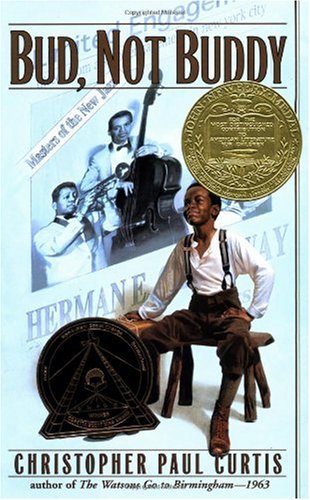
Curtis, Christopher Paul. Bud, Not Buddy. New York: Scholastic, Inc., 1999.

Summary:
This book recounts the story of Bud Caldwell, a young African-American orphan living in Michigan during the Great Depression.  After a disastrous experience with a foster family, Bud decides to run away from his home town in order to find his father, whom he has never met.  With everything that he owns in an old suitcase, Bud sets out for Grand Rapids, Michigan and, with some help along the way, finds the man who he thinks is his father only to be encountered with a surprise and a new home.

My Impressions:
This story is a creative one that includes historical details of the Great Depression, including bread lines and Hoovervilles.  The character of Bud is an easy to like ten year old boy, who just wants to find where he belongs.  The book is excellently written, and provides the young reader a glimpse into the life of someone like themselves, but in a different era.  Readers will grow fond of the young main character and will love the unexpected ending.


Suggestions for the use of this book:
This book could be used for any lesson on life during the Great Depression.  This book provides a child's insight into what life would be like for a child growing up during this era.


Reviews:
Andersen, Beth E. Review of Bud, Not Buddy, by Christopher Paul Curtis. Voice of Youth Advocates, February 2, 2000.
Curtis's magical touch in his debut novel, The Watsons Go to Birmingham-1963 (Delacorte, 1995), is once again evident in all its powerful, funny glory in his latest lovely novel. Ten-year-old Bud Caldwell, wise beyond his years, is hit particularly hard by the Depression in 1936. Bud has been bounced back and forth between a Flint, Michigan, orphanage and foster care since his mother died when he was six. Fed up with beatings from those who take him in, Bud grabs his few meager treasures and sets out in search of his father. With determination and a cautious but curious spirit, Bud heads for Grand Rapids, home of Herman E. Calloway, legendary bass player and leader of a renowned jazz band. Convinced that Calloway is his long-lost father, Bud seeks a reunion. Bud's only guidebook is Bud Caldwell's Rules and Things for Having a Funner Life and Making a Better Liar out of Yourself, his own set of poignant, riotous tips for preserving sanity. In a scene of stunning hilarity, Bud is rescued by Lefty Lewis, who takes Bud to Grand Rapids, where the child learns yet again that life is not always what it seems. Curtis writes with a razor-sharp intelligence that grabs the reader by the heart and never lets go. His utterly believable depiction of the self-reliant charm and courage of Bud, not Buddy, puts this highly-recommended title at the top of the list of books to be read again and again.

Sunday, February 13, 2011

Module 4: The Westing Game and Lincoln: A Photobiography

Citation:
Raskin, Ellen. The Westing Game. New York: E.P. Dutton, 1978.

Summary:
This fast paced suspenseful mystery revolves around a group of people who are selected to occupy apartments in a newly constructed high rise apartment building.  These people all have a connection to the mysterious Samuel Westing who disappeared many years prior to the story.  One of the tenants of the apartment builidng, a young girl, discovers Westing's corpse in his deserted mansion, and the mystery begins there.  All of the tenants of the apartment building are invited to the old Westing mansion and are given clues which will supposedly lead them to the death of Westing, as well as a substantial inheritance.  Throughout their efforts to solve the puzzle, the characters find out that nobody is who they seem to be, and eventually only one person is able to correctly solve the mystery.

My Impressions:
This book is excellently written and put together.  The mystery appeals to children, as one of the characters who stands out the most is a young girl who is lives in the shadow of her older sister.  The young reader will be able to identify with this girl, who ultimately is the only one who puts the clues together in order to solve the mystery of Samuel Westing's death.  The book does not go above the reading level of most children, but does not appear completely childlike in its plot.  Added in with the cleverly written plot is humor that children will enjoy.  On the whole, this book was an excellent choice for the Newbury award, as it proves to be a good piece of children's literature that holds appeal for young readers.

Suggestions for the use of this book:
This book would be excellent to recommend to any child who shows an interest in puzzles, riddles, or mysteries.  This would also be a good book to aid young readers in doing character analyses, as the characters in this book are easy to analyze.

Reviews:
Cooperative Children's Book Center Choices. Review of The Westing Game, by Ellen Raskin. 2003.
Turtle Wexler isn't the kind of child who turns down a dare. A chance to earn two dollars a minute for venturing into the deserted Westing house appeals to her mercenary instincts (her quick calculation shows that a mere 25 minutes inside the house would cover a subscription to The Wall Street Journal). The corpse that Turtle discovers mid-dare marks her entry into The Westing Game, in which sixteen unlikely individuals vie for the opportunity to inherit the deceased man's fortune. Winner of the 1979 Newbery Medal, Ellen Raskin's timeless mystery is an intricate construction of clues, wordplay, dead ends, and last minute surprises. More than a clever puzzle, the interactions of the potential heirs offer insight into relationships, love, differences, and tolerance.

Citation:
Freedman, Russell. Lincoln: A Photobiography. New York: Clarion Books, 1987.

Summary:
This biography of Abraham Lincoln, as the title and genre suggest, provides an account of Lincoln's life through the use of both narrative and contemporary photographs and prints.  The book covers Lincoln's life from his humble birth, to his stormy presidency, and finally to his now famous assassination.  Also included in the book, are samples of Lincoln's speeches and writings, as well as a list of historic places associated with Lincoln. 

My Impressions:
This is an excellent biography to recommend to a young reader.  The combined use of narrative and photographs makes the life of Abraham Lincoln come to life for the reader.  In addition, the narrative is not written in such a way that it would be over the head of its intended reading level, nor does the narrative talk down to children as some other biographies do.  This book allows the young reader to easily understand and follow Lincoln's life, as well as visualize it.

Suggestions for the use of this book:
This would be an excellent book to recommend to a child who either has difficulty reading or does not enjoy reading as the photographs would make it easier for a child to visualize what they cannot understand or do not wish to read about.  In addition, this book could be used to recommend to a child doing a school report on Lincoln, and of course could be used in any lesson about Abraham Lincoln.

Reviews:
Review of Lincoln: A Photobiography, by Russell Freedman. Booklist, December 15, 1987.
Loved, revered, idealized, ``more books have been written about Abraham Lincoln than any other American.'' In a calm, unemotional style Freedman seeks to dispense with the romanticized folk-hero imagery and misconceptions; for example, he notes that the long ``freeze'' exposure photography process of the time, which resulted in stiff and formal poses, never did justice to the real Lincoln. The author points out that while Lincoln was witty and talkative in company he rarely betrayed his inner feelings and was never fully understood by even his closest friends. Freedman traces Lincoln's early years and study of law and comments on his fierce ambition to rise above his log-cabin origins. The harsh emotional pain, melancholy, and depression endured by Lincoln and his wife Mary throughout their lives are also made clear. The antidote Lincoln so frequently used his wit and rollicking humor is seen in sharp contrast, making the accomplishments of this complex man all the more awe-inspiring. Following the account of the presidential/war years and assassination, Freedman includes a sampler of quotations from Lincoln's writings and speeches and a listing of historic sites. This eminently well-researched photo biography is outstanding; the man, his times, and his contemporaries are compellingly portrayed.

Weischedel, Elaine Fort. Review of Lincoln: A Photobiography, by Russell Freedman. School Library Journal, December 1, 1987.
Few, if any, of the many books written for children about Lincoln can compare with Freedman's contribution. More than 80 photographs and prints illustrate the crisp and informative text. The pictures have been well-placed to coordinate with the text; captions have been written with care as well. While many of the photographs are well-known, many less familiar pictures are also included. Freedman begins by contrasting the Lincoln of legend to the Lincoln of fact. His childhood, self-education, early business ventures, and entry into politics comprise the first half of the book, with the rest of the text covering his presidency and assassination. Freedman's extensive research is apparent in the liberal use he makes of quotations from original sources (letters, contemporary newspaper articles, etc.). Freedman makes clear the controversy and vilification that Lincoln engendered and endured during his presidency. A listing of historic sites open to the public and a sampler of wise and witty excerpts from Lincoln's writings complete the book. Well-organized and well-written, this is an outstanding example of what (juvenile) biography can be. Like Lincoln himself, it stands head and shoulders above its competition.

Sunday, February 6, 2011

Module 3: The Invention of Hugo Cabret and Flotsam

Citation:
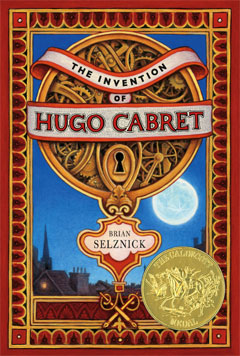
Selznick, Brian. The Invention of Hugo Cabret. New York: Scholastic Press, 2007.

Summary:
The book revolves around the character of a young boy named Hugo Cabret who is living inside the walls of a Paris train station in 1931.  He has lived in the train station since the untimely death of his father in a museum fire, after which he was taken to live with his uncle who kept the clocks running in the train station.  Hugo has one link to his father which is a mechanical machine formed to look like a person holding a pen over a writing desk.  This machine was found by Hugo's father, and he was in the process of restoring it when he died.  Hugo spends his free time attempting to fix the machine, and in order to do so must steal mechanical parts from a toymaker who has a booth inside the train station.  When he is caught by the toymaker, he begins learning that the automaton his father was restoring and the toymaker are linked together, culminating in the revelation of the toymaker's true identity. 

My impressions:
This is an expertly written and illustrated book which moves quickly.  The use of illustrations to tell large parts of the story is well done, so that the reader feels as if they are watching a black and white movie rather than reading a book, which ties in with the plot of the book which involves the early days of film.  While the illustrations lack color, they are rich in detail so that the reader misses no part of the plot due to lack of words.  In addition, the storyline is well thought out with questions brought up that are later answered at just the right time.  This technique makes the book suspenseful and a fast read. 

Suggestions for the use of this book:
This book is an excellent choice to recommend to older children who do not necessarily enjoy reading.  The fast moving plot and the large amount of pictures would, theoretically, make the book enjoyable to the child who does not like to read, or even a child who has trouble reading.  They will be able to grasp the plot from the illustrations, and then will have read a quality book that they find enjoyable.

Reviews:
Lukehart, Wendy. Review of The Invention of Hugo Cabret, by Brian Selznick. School Library Journal, March 1, 2007.
With characteristic intelligence, exquisite images, and a breathtaking design, Selznick shatters conventions related to the art of bookmaking in this magical mystery set in 1930s Paris. He employs wordless sequential pictures and distinct pages of text to let the cinematic story unfold, and the artwork, rendered in pencil and bordered in black, contains elements of a flip book, a graphic novel, and film. It opens with a small square depicting a full moon centered on a black spread. As readers flip the pages, the image grows and the moon recedes. A boy on the run slips through a grate to take refuge inside the walls of a train station-home for this orphaned, apprentice clock keeper. As Hugo seeks to accomplish his mission, his life intersects with a cantankerous toyshop owner and a feisty girl who won't be ignored. Each character possesses secrets and something of great value to the other. With deft foreshadowing, sensitively wrought characters, and heart-pounding suspense, the author engineers the elements of his complex plot: speeding trains, clocks, footsteps, dreams, and movies-especially those by Georges Melies, the French pioneer of science-fiction cinema. Movie stills are cleverly interspersed. Selznick's art ranges from evocative, shadowy spreads of Parisian streets to penetrating character close-ups. Leaving much to ponder about loss, time, family, and the creative impulse, the book closes with a waning moon, a diminishing square, and informative credits. This is a masterful narrative that readers can literally manipulate.

Mattson, Jennifer. Review of The Invention of Hugo Cabret, by Brian Selznick. Booklist, January 1, 2007.
Selznick's novel in words and pictures, an intriguing mystery set in 1930s Paris about an orphan, a salvaged clockwork invention, and a celebrated filmmaker, resuscitates an anemic genre the illustrated novel\emdash and takes it to a whole new level. The result is somewhat similar to a graphic novel, but experiencing its mix of silvery pencil drawings and narrative interludes is ultimately more akin to watching a silent film. Indeed, movies and the wonder they inspire, like seeing dreams in the middle of the day, are central to the story, and Selznick expresses an obvious passion for cinema in ways both visual (successive pictures, set against black frames as if projected on a darkened screen, mimic slow zooms and dramatic cuts) and thematic (the convoluted plot involves director Georges Melies, particularly his fanciful 1902 masterpiece, A Trip to the Moon.) This hybrid creation, which also includes movie stills and archival photographs, is surprising and often lovely, but the orphan's story is overshadowed by the book's artistic and historical concerns (the heady extent of which are revealed in concluding notes about Selznick's inspirations, from the Lumiere brothers to Franeois Truffaut). Nonetheless, bookmaking this ambitious demands and deserves attention, which it will surely receive from children attracted by a novel in which a complex narrative is equally advanced by things both read and seen.

Citation:
Wiesner, David. Flotsam. New York: Clarion Books, 2006.

Review:
This children's book is made up of entirely illustrations, and recounts the story of a young boy who finds an underwater camera that has washed up on the beach.  He develops the film inside of the camera and is taken into the under sea world.  He also finds that he is not the first person to find the camera.  He finds that one of the pictures is of a child hold a picture of another child, who is holding the picture of another child, and so on.  He is able to use his microscope to see that the camera has been traveling for many years.  The boy puts a new roll of film into the camera, and throws it back into the ocean so that it can take more pictures, and find another child.

My impressions:
The illustrations in this book are so detailed that words are not necessary for the reader to grasp the story.  Through his intricate illustrations, Wiesner mixes reality with the absurd, and is able to connect children together from different places in the world, and different eras in time.  This book is truly unique, and it is almost impossible to describe just how phenomenal the illustrations and book are.

Suggestions for the use of this book:
This would be an excellent book for children to narrate.  They could use the illustrations provided to add words to the story.  This would work on their comprehension and writing skills at the same time.

Reviews:
Fleishhacker, Joy. Review of Flotsam, by David Wiesner. School Library Journal, September 1, 2006.
A wave deposits an old-fashioned contraption at the feet of an inquisitive young beachcomber. It's a "Melville underwater camera," and the excited boy quickly develops the film he finds inside. The photos are amazing: a windup fish, with intricate gears and screwed-on panels, appears in a school with its living counterparts; a fully inflated puffer, outfitted as a hot-air balloon, sails above the water; miniature green aliens kowtow to dour-faced sea horses; and more. The last print depicts a girl, holding a photo of a boy, and so on. As the images become smaller, the protagonist views them through his magnifying glass and then his microscope. The chain of children continues back through time, ending with a sepia image of a turn-of-the-20th-century boy waving from a beach. After photographing himself holding the print, the youngster tosses the camera back into the ocean, where it makes its way to its next recipient. This wordless book's vivid watercolor paintings have a crisp realism that anchors the elements of fantasy. Shifting perspectives, from close-ups to landscape views, and a layout incorporating broad spreads and boxed sequences, add drama and motion to the storytelling and echo the photographic theme. Filled with inventive details and delightful twists, each snapshot is a tale waiting to be told. Pair this visual adventure with Wiesner's other works, Chris Van Allsburg's titles, or Barbara Lehman's The Red Book (Houghton, 2004) for a mind-bending journey of imagination.

Review of Flotsam, by David Wiesner. Publisher's Weekly, July 24, 2006.
Two-time Caldecott winner Wiesner (Tuesday; The Three Pigs) crafts another wordless mystery, this one set on an ordinary beach and under an enchanted sea. A saucerlike fish's eye stares from the exact center of the dust jacket, and the fish's scarlet skin provides a knockout background color. First-timers might not notice what's reflected in its eye, but return visitors will: it's a boxy camera, drifting underwater with a school of slim green fish. In the opening panels, Wiesner pictures another close-up eye, this one belonging to a blond boy viewing a crab through a magnifying glass. Visual devices binoculars and a microscope in a plastic bag rest on a nearby beach towel, suggesting the boy's optical curiosity. After being tossed by a wave, the studious boy finds a barnacle-covered apparatus on the sand (evocatively labeled the "Melville Underwater Camera"). He removes its roll of film and, when he gets the results, readers see another close-up of his wide-open, astonished eye: the photos depict bizarre undersea scenes (nautilus shells with cutout windows, walking starfish-islands, octopi in their living room ? la Tuesday's frogs). A lesser fantasist would end the story here, but Wiesner provides a further surprise that connects the curious boy with others like him. Masterfully altering the pace with panel sequences and full-bleed spreads, he fills every inch of the pages with intricate, imaginative watercolor details. New details swim into focus with every rereading of this immensely satisfying excursion.