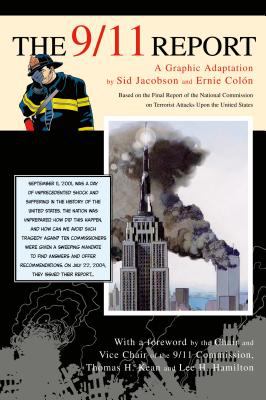
Jacobson, Sid, and Ernie Colon. The 9/11 Report: A Graphic Adaptation. New York: Hill and Wang, 2006.
Summary:
Jacobson and Colon have taken the report produced by the National Commission on Terrorist Attacks Upon the United States, and made it into a graphic novel. This was done so that the report could be put into a format that adults and young adults would be more likely to read and understand. This adaptation takes the reader from events leading to the terrorists' plan to attack the United States, to an analysis and recommendations for improvement of response of the government to the attacks.
My Impressions:
While not typically a fan of graphic novels, this one is an engrossing read. Jacobson and Colon have done an excellent job of presenting the facts from the official report in such a way that people will be more likely to read and understand the events of that day. The illustrations are typical of graphic novels, and therefore illustrate what the text states. The majority text used is taken from the report directly, but is presented in the form of dialogue along with illustrations which aid in the understanding of the report. The book is interesting and informs the reader in a way that a dry government report never could. This format of presenting a historical event, if it is as well done as this book, could be a new method of making history interesting to students.
Suggestions for the use of this book:
This book could be used in a history lesson on the events of September 11th, especially as the generation of children who were either to young to understand and remember the events of that day or weren't born yet, grow up and begin learning about this in school. This would be a good read for students, as it is factual and presented in a format that they enjoy.
Reviews:
Kral, Steven. Review of The 9/11 Report: A Graphic Adaptation, by Sid Jacobson and Ernie Colon. Voice of Youth Advocates, June 1, 2007.
The 9/11 Commission Report on the events of that day weighs in at a formidable eight hundred pages of small text. Developed with the blessing and support of the Commission, this volume condenses the eight-hundred-page report and uses the graphic novel format both to streamline the retelling of events and to enable the report to reach a new audience. The book begins by retelling what happened that morning and then details what factors led to the attack. It ends with a series of recommendations to prevent the recurrence of similar events in the future. Although a September 11 comic book might not sound like a good idea, this book does a great job in making the report accessible. The format enables the reader to understand how synchronous events thousands of miles away from each other combined to devastating results. The majority of the text is taken from the report and is largely used for narration or documented remarks. Text that is not from the report is used for dramatic effect and is readily apparent. It does, however, require active participation from the reader to fit the pieces together. It follows the report's structure, rather than providing a chronological narrative. This technique tends occasionally to force the reader to flip back a few pages to remember who was who. Although this problem might cut down on its appeal, students looking for an accessible way to approach the 9/11 Report will seek out this book.
Goldsmith, Francisca. Review of The 9/11 Report: A Graphic Adaptation, by Sid Jacobson and Ernie Colon. School Library Journal, December 1, 2006.
At only 15 percent the size of The 9/11 Report: The National Commission on Terrorist Attacks upon the United States (St. Martin's, 2004) and more than four times the price, is this adaptation worth purchasing? The answer is an unequivocal yes. Jacobson and Col-n intend this adaptation to bring to the commission's report readers who would not or could not digest its nearly 800 pages, and they have the blessing, acknowledged in this book's foreword, of the commission's chair and vice-chair to do so. Neither lurid nor simplistic, it presents the essence of the commission's work in a manner that, especially in the opening section, is able to surpass aspects of any text-only publication: the four stories of the doomed flights are given on the same foldout pages so that readers can truly grasp the significance of how simultaneous events can and did overwhelm our national information and defense systems. The analysis that follows in the subsequent 11 chapters cuts cleanly to the kernels of important history, politics, economics, and procedural issues that both created and exacerbated the effects of the day's events. Col-n's full-color artwork provides personality for the named players-U.S. presidents and Al-Qaeda operatives alike-as well as the airline passengers, office workers, fire fighters, and bureaucrats essential to the report. This graphic novel has the power and accessibility to become a high school text; in the meantime, no library should be without it.

No comments:
Post a Comment